Back
Back
 My Account
2026 AWARD WINNER | University of Lancashire MA Ceramics
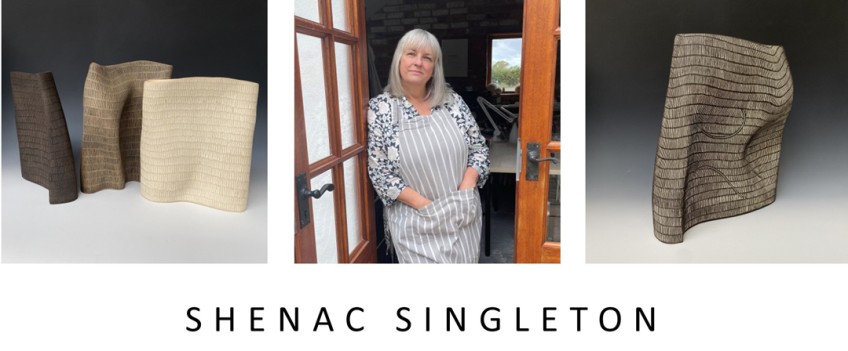
Shenac Singleton | MA Ceramics - Recipient of the Potclays Graduate Award in 2026 as part of our Educlaytion programme.
Tell us a bit about your journey into ceramics. What moments or decisions have shaped your practice most so far?
My journey into ceramics has been something of a gradual evolution rather than a clearly defined career path. Throughout my career I have always been involved in the arts, initially through graphic design and printmaking before moving into bespoke picture framing and running a small gallery. Although I had worked creatively for many years, it was ceramics that eventually gave me the opportunity to explore ideas in a much more tactile and physical way.
The decision to undertake an MA in Ceramics in my early sixties was probably the most significant step I have taken in developing my practice. It gave me the time and space to question what I wanted my work to say and, importantly, to slow down and allow my own visual language to emerge.
My MA research, Memories of Place, brought together my longstanding interest in the patterns and textures found within the landscape with a growing fascination with how memory and emotion can be expressed through form. Finishing the MA feels less like an ending and more like the beginning of the next stage of my practice.
Do you remember your first meaningful experience with clay? What stayed with you from that moment?
My first meaningful experience with clay came at a time when I was looking for something to change the direction of my life. I had recently divorced, my children had left home for university and, although I was working during the day, I found myself spending every evening sitting in the same spot on the settee watching television. I realised I needed to do something different.
At the time I was a printmaker, creating original lino prints, but I had lost both my interest and motivation. I knew I needed something creative, but also something that would challenge me. A close friend, who was a ceramic artist, persuaded me to try clay.
I enrolled on a one-year evening course, not really knowing what to expect. I had never worked three-dimensionally before, and working with clay was something of a revelation. I still find thinking in three dimensions challenging, but perhaps that is part of what continues to draw me to clay — the constant challenge of resolving a form.
What drew you to ceramics over other disciplines, and what keeps you committed to it?
I think what drew me to ceramics was the combination of the visual and the physical. Coming from a design and printmaking background, I have always been interested in line, shape, proportion and composition, but clay introduced another dimension — touch, form and space.
There is something very immediate about building a form with your hands. You can see and feel a piece developing at the same time, and the material continually responds to what you are doing. I also enjoy the fact that the process cannot be completely controlled. Drying, firing, glaze and surface can all introduce an element of unpredictability.
That combination of control and chance keeps me committed to ceramics. I can begin with a very considered idea, but the finished piece is always influenced by the material and the making process. I find that tension between the planned and the intuitive endlessly interesting.
What tends to spark new ideas in your work, and how do those influences show up in what you make?
Landscape is probably the strongest starting point for my ideas, particularly around Sawbridge in Warwickshire, which has become an important reference point for my work.
I am interested less in representing a landscape literally and more in distilling something of its character — its contours, rhythms, textures and changing atmosphere. I often begin with a mapped contour or a particular line within the landscape and allow that to become the starting point for a sculptural form.
Memory is equally important. I am interested in those fleeting moments when a particular place becomes emotionally significant — a change in light, the colour of grasses, the first frost or the feeling of a particular season. These influences appear in my work through form, surface, colour and mark-making rather than as literal representations.
I want the finished pieces to retain something of that sense of place, while leaving room for the viewer to bring their own associations and memories to them.
Which tools, materials, or techniques have become essential to your way of working, and why?
My work is hand-built, and working with coils and slabs has become particularly important to the way I construct my forms. I enjoy the sense of building, as it allows me to respond to the developing shape and make subtle adjustments as I go.
I also rely on very simple tools — knives, ribs, wooden tools and anything that allows me to cut, compress, smooth or mark the surface. I don't think the tools themselves are particularly important; it is what they allow me to do with the clay that matters.
Clay bodies have also become an important part of my visual language. I have experimented with black and white stoneware bodies, mixing clay bodies to create tonal variation and exploring different surface treatments. Incised lines, texture and mark-making have become particularly important, allowing me to introduce another layer of landscape into the work.
What’s something in your process that rarely goes to plan?
Some of the most interesting discoveries in my work have come from things that didn't quite go according to plan. The making process itself rarely follows the path I envisage before I start. A piece may begin with a very definite idea, but as it develops I often change the form, alter the surface or abandon something altogether.
I've become much more comfortable with that uncertainty. Rather than seeing it as failure, I try to regard it as part of the dialogue between myself and the clay — a conversation between the intended form and the hands that are making it.
Then, of course, there is the firing process! You can spend weeks constructing a piece, refining the form and developing the surface, and then put it into the kiln with a fairly clear idea of what you expect to happen. Once the kiln is closed, however, there is very little you can do. Clay can move, crack, warp or behave in ways you simply hadn't anticipated, and surfaces can look very different after firing.
Where do you allow yourself to take risks in your work?
I think I take most risks in the areas where I am least certain of the outcome — particularly surface, colour and the relationship between different elements of a form.
My starting point is often quite controlled. I may begin with a mapped contour or a line derived from the landscape, but I then try to allow the making process to become more intuitive. I have learned that if I control every aspect of a piece, I can sometimes lose the sense of life within it.
During my MA I became increasingly interested in pushing the surface of my work, experimenting with texture, incised lines, layered marks and different clay bodies. More recently, I have also been exploring coloured clay, which opens up another set of possibilities.
For me, taking a risk doesn't necessarily mean making something dramatic. Sometimes it is simply allowing myself to move away from what I know works and accepting that the result might be unexpected.
What does a day in your studio actually look like, from start to finish?
There probably isn't a completely typical studio day, which is one of the things I enjoy about working independently.
I might arrive with a very specific task in mind — constructing a new form, refining a piece or working on a surface — but quite often the day evolves from what is already happening in the studio. I may begin by checking pieces that are drying, looking at work in progress and deciding what needs attention next.
A lot of my time is spent making, but there is also considerably more thinking than people might imagine. I sketch, work in my sketchbook, photograph pieces, look at them from different angles and make notes about what is and isn't working.
There are also the less glamorous jobs: preparing clay, cleaning tools, wedging, making test pieces and cleaning the studio! I actually enjoy that rhythm. Ceramics requires patience, and sometimes the most productive thing I can do is simply stop, look and allow an idea to develop rather than forcing it.
What are you hoping to explore or push further in your practice over the next year?
Now that I have completed my MA, I am excited about allowing the work to develop without the structure of an academic course around it. I don't want to move too quickly into producing work simply because I feel I should. I want to give myself time to see where the ideas naturally lead.
I would like to develop the relationship between contour, form and surface further, while continuing to explore how landscape and memory can be distilled into increasingly pared-back sculptural pieces. Coloured clay is another area I am keen to return to and develop, particularly the possibilities of using colour within the body of the clay rather than simply applying it to the surface.
I also want to begin testing my work in a wider professional context — approaching galleries, applying for selected exhibitions and developing a stronger presence as an emerging ceramic artist.
The next year feels like a transition: moving from being a student to establishing myself as an artist in my own right.
What do you wish someone had told you when you were studying ceramics?
I think I would have liked someone to tell me that there is no particular age or timetable for developing and evolving as an artist. My own creative journey has moved through graphic design, painting, printmaking and eventually ceramics, with each stage influencing the next.
Starting an MA in my sixties was a huge decision, and at times I wondered whether I was trying to do too much or whether I should already have known exactly where my work was going. Looking back, I realise that a creative practice is never really finished. You have to allow yourself to experiment, make mistakes, change direction and sometimes make work that doesn't succeed.
I would also say: don't be too concerned about finding your 'style'. If you keep working, looking, questioning and making, your own visual language gradually begins to emerge.
And perhaps most importantly, don't underestimate the value of giving yourself time. Some ideas need to sit quietly for a while before they become something. The work doesn't always need to be resolved immediately.
Instagram: www.instagram.com/shenac.art/ Website: www.shenac.co.uk