Back
Back
 My Account
2026 AWARD WINNER | Loughborough University
Tayla Harding | BA Fine Art - Recipient of the Potclays Graduate Award in 2026 as part of our Educlaytion programme.
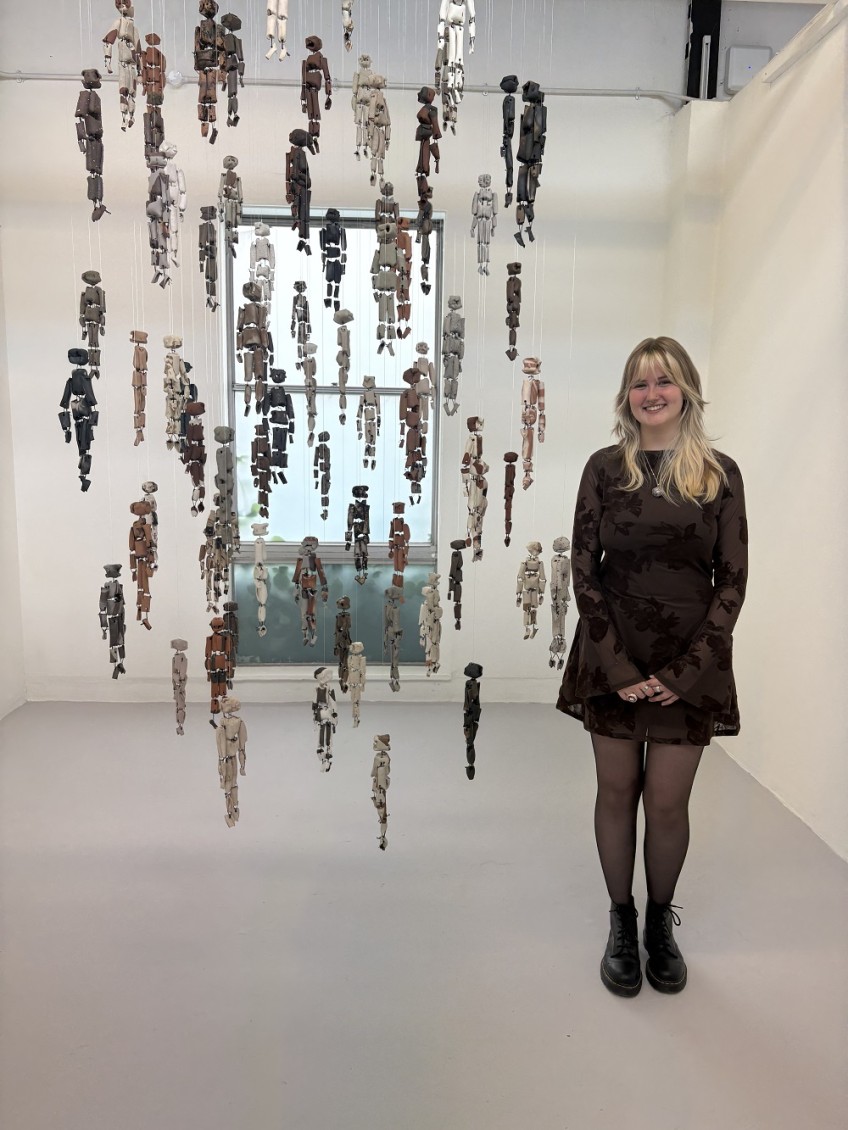
TAYLA HARDING Loughborough University | BA Fine Art
Recipient of the Potclays Graduate Award in 2026 as part of our Educlaytion programme
Tell us a bit about your journey into ceramics. What moments or decisions have shaped your practice most so far?
I started university as a painter, but I found the process really stressful and was rarely happy with the final result. At the end of my first year, I moved into ceramics with the idea of creating work that combined both painting and ceramic processes. During this transition, I made a plaster mould of a doll's head and learned how to slip-cast with porcelain. That experience was a turning point for me. From that point onward, I haven't looked back. I fell in love with ceramics and the possibilities it offered, and it has become the foundation of my practice ever since.
Do you remember your first meaningful experience with clay? What stayed with you from that moment?
The first meaningful experience I had with clay was probably the first time I used it to create a finished piece. Throughout the process, I was a bit unsure of myself, but once the work came out of the kiln and was glazed, I knew this was what I wanted to do. The joy and excitement I felt when I held the finished piece in my hands was incomparable and unlike anything I had experienced with any other medium. There is something incredibly exciting about opening a kiln and seeing how your work has turned out. That sense of anticipation and discovery is still one of my favourite parts of working with ceramics.
What drew you to ceramics over other disciplines, and what keeps you committed to it?
What drew me to ceramics was the unpredictability of both the material and the glaze. Things do not always turn out the way you expect, and that has taught me the art of letting go. It has opened me up to different possibilities and encouraged me to be more flexible and accepting of unexpected results. What keeps me committed to ceramics is that sense of discovery. The unpredictability means that every piece is unique, and I love that no two outcomes are ever exactly the same. It is a medium that continually surprises me and pushes me to embrace experimentation in my practice.
What tends to spark new ideas in your work, and how do those influences show up in what you make?
When experimenting with clay, it feels like making through play. I find the process very intuitive, and that allows me to create work that feels genuinely personal and true to what I want to make. I did not have that experience with other mediums. I often found myself being too strict with my expression and not allowing myself to enjoy the process, which usually affected the final outcome. It is my love for this process that gives my work its distinct style. I have learned to let go of the need for complete control and allow the clay to have a say in its appearance. Rather than hiding the making process, I often exaggerate and celebrate it.
Curiosity is a major source of inspiration in my practice. This is reflected in my most recent work, where I tested different firing temperatures, firing techniques, slips, and inclusions within a single piece. I wanted to push the clay to its limits and explore the different forms and surfaces it could take. Through this kind of experimentation, new ideas often emerge naturally and shape the direction of my work.
Which tools, materials, or techniques have become essential to your way of working, and why?
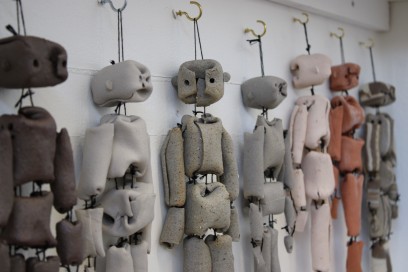
Hand-building through rolling and folding clay, inspired by Mo Jupp, has become a key technique in my practice. I am drawn to this method because it allows for individual differences to emerge and makes the process of making visible within the final work. The technique itself requires very few tools in the early stages, which helps keep the process direct and intuitive. Towards the end, I use a loop tool to create holes in the clay that allow separate pieces to be joined together after firing.
What’s something in your process that rarely goes to plan?
Something in my process that rarely goes to plan is the glazing process. At first, I found this frustrating, and the unpredictability of the colour and surface qualities was difficult for me to accept. However, I soon changed my outlook and began approaching the process without expectations for the final result.
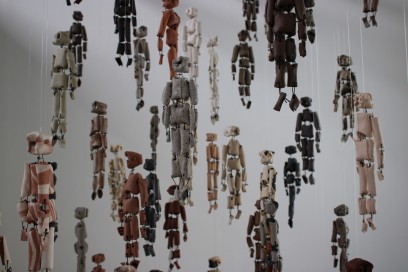
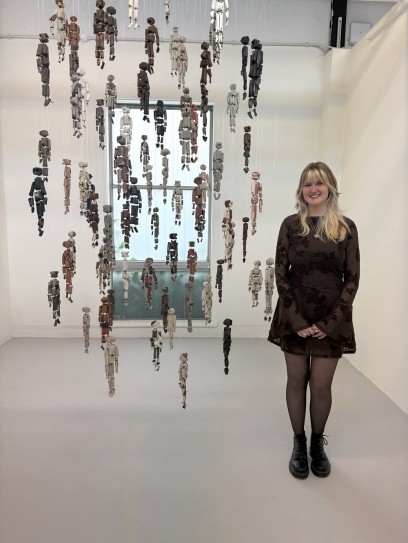
In my most recent installation, I did not use glaze at all. Instead, I used inclusions, slips, and different firing temperatures to create a range of responses within the clay itself. I wanted to explore what the material was capable of, allowing it to take centre stage rather than covering it up. Even this process remained unpredictable, but that uncertainty became part of the work. Rather than aiming for a specific outcome, I was interested in the clay's response to different conditions. Because of that, there was no right or wrong result, only an opportunity to discover something new.
Where do you allow yourself to take risks in your work?
I would say that I take risks at every stage of my process. I often work in multiples that differ in material, surface, and appearance, which means there are many opportunities for unexpected outcomes. It is not unusual for pieces to unfold while drying, break during transport, or depending on the materials used, fuse together in the kiln. These risks are an inherent part of the way I work. If I were not willing to accept them, I would find the process much more stressful.
What does a day in your studio actually look like, from start to finish?
I usually get into the studio around 10am. Due to the repetitive nature of my practice, my days often follow a similar structure. I spend most of my time repeating the same processes with slightly different materials, slips, or firing approaches in order to create a wide range of outcomes.
Although the process can be quite methodical and sometimes tedious, I find it rewarding because each variation produces a different result. Much of my work is driven by experimentation, so even when the actions are repetitive, there is always an element of discovery. At the end of the day, I sort the individual pieces into tubs according to their firing type and temperature, then move them onto the drying racks. After that, I tidy the studio and head home, ready to continue the process the next day.
What are you hoping to explore or push further in your practice over the next year?
I have thoroughly enjoyed experimenting with the materiality of clay and its reactions to different inclusions, such as metal filings and feldspar chips, as well as observing how it changes under different firing conditions. Over the next year, I hope to continue these experiments and deepen my understanding of how different clay bodies respond to these interventions. I am also interested in reintroducing glazes into this process to see how they interact with the inclusions and whether they produce different results across different clay types. I am excited by the possibility of uncovering new surface qualities and responses through this continued experimentation.
What do you wish someone had told you when you were studying ceramics?
Allow yourself to make mistakes, have fun with the material and you will make something that is uniquely you