Back
Back
 My Account
2026 Award Winner | University of Staffordshire
Genevieve Mann | BA Product, Furniture & Ceramics - Recipient of the Potclays Graduate Award in 2026 as part of our Educlaytion programme.
GENEVIEVE MANN University of Staffordshire | BA Product, Furniture & Ceramics
Recipient of the Potclays Graduate Award in 2026 as part of our Educlaytion programme
Tell us a bit about your journey into ceramics. What moments or decisions have shaped your practice most so far?
The reason I started using ceramics was actually due to my older sister. She attended the same college I was going to, I had seen her previous projects and was curious to know which class she took that used clay because I wanted to ‘mess about with it’. I had originally thought I was going to pursue a degree in my other subject choices so I was going to use this class as a chance to take a break from them and have fun and exercise a part of my creativity I hadn't done before. However, the more I used clay, the more research I did, and I started to notice how much I enjoyed using my free time to practice. When starting out my journey into ceramics, as my knowledge was rudimentary, I was able to build my skills from the ground up, using slab building, and hand building. I believe this informed my university projects a lot as I was able to know more about the capabilities of clay, outside of using moulding.
Do you remember your first meaningful experience with clay? What stayed with you from that moment?
My first meaningful experience with clay wasn't actually with the clay itself but the experience around it. I started using clay in my project while in my 3D design class at college in 2022, opting to use clay as I didn't like the idea of laser cutting wood to make structures. I was the only person in my class opting to use clay as my main material and based all of my projects on it. One day it became apparent to me that some of my classmates kept coming to me asking me questions on how to handle clay and how to do what they wanted properly. I remember feeling so confident in my knowledge and proud that I had learned something and was able to help others. Now, when I feel frustrated and insecure in my skills, I go back to that moment in college, where people looked towards me with faith that I could answer all of their questions.
What drew you to ceramics over other disciplines, and what keeps you committed to it?
I was drawn to ceramics by the sheer versatility of the material. The possibilities really do seem endless, and I couldn't really see that in other materials. It is due to this versatility that I am still committed to ceramics. The thought of making new pieces really excites me, and I've never had that with other materials, or even any other subject I have studied before. Also, due to the slowing pottery industry, I feel more fired up with motivation to succeed, to create something to be used over a lifetime, which would be unlikely with other practices.
What tends to spark new ideas in your work, and how do those influences show up in what you make?
I spend a LOT of time on social media. I find a lot of joy in looking at different corners of the internet, taking in other countries' trends, looking at subjects such as tattoos,literature, music, pop culture, fashion, interiors and trending colour combinations. All of these influence how I design and spark new ideas. Another big source of inspiration is the people around me. I find that there is so much joy in designing a project based on the lives of those you love. For example, for my most recent project I was inspired by the generations of women in my family who were weavers in old mills. Because of this inspiration I was able to create a pattern to be used on my pieces inspired by an abstract interpretation of a weaving pattern. I believe that by using those around you as inspiration, the design will have more gravity to you than other ideas.
Which tools, materials, or techniques have become essential to your way of working, and why?
Throughout my time at university, I have found great enjoyment in designing my pieces through CAD (computer-aided design) rather than only pen and paper. This method has become essential to me and I can visualise the design clearer while also being made aware of the flaws/inaccuracies in the design due to the CAD model. As an accompaniment to this skill, as I use CAD to design my pieces, in my process I have the model 3D printed. This method ensures an accurate model to make a plaster mould of, instead of hand making the model yourself. Throughout my projects at university, I have relied on the use of plaster moulds and slip casting, as I believe that using a mould creates less room for error, and as long as you have a well-made model, you can make successful ceramic casts of it.
What’s something in your process that rarely goes to plan?
My previous answer being said, one thing that almost always goes wrong is creating a plaster mould from the 3D printed model. Depending on the complexity of design, the attention to detail needed on the 3D model increases. For example, when designing your model in CAD, you need to make sure all of the edges are rounded enough so the plaster can come out, if not, the plaster will stick in there and you will struggle to get it out. Because of this I’ve become very acquainted with the 3D print technicians at the university as I almost always have to come back with a revision of my design needing to be printed!
Where do you allow yourself to take risks in your work?
I allow myself to take risks through the glazing section of my process. This is because I make sure that when casting, I have a lot of duplicates, to minimize room for error. Because of this planning, when it comes to glazing, I allow myself to use a few pieces to experiment without being scared of it not going to plan.
What does a day in your studio actually look like, from start to finish?
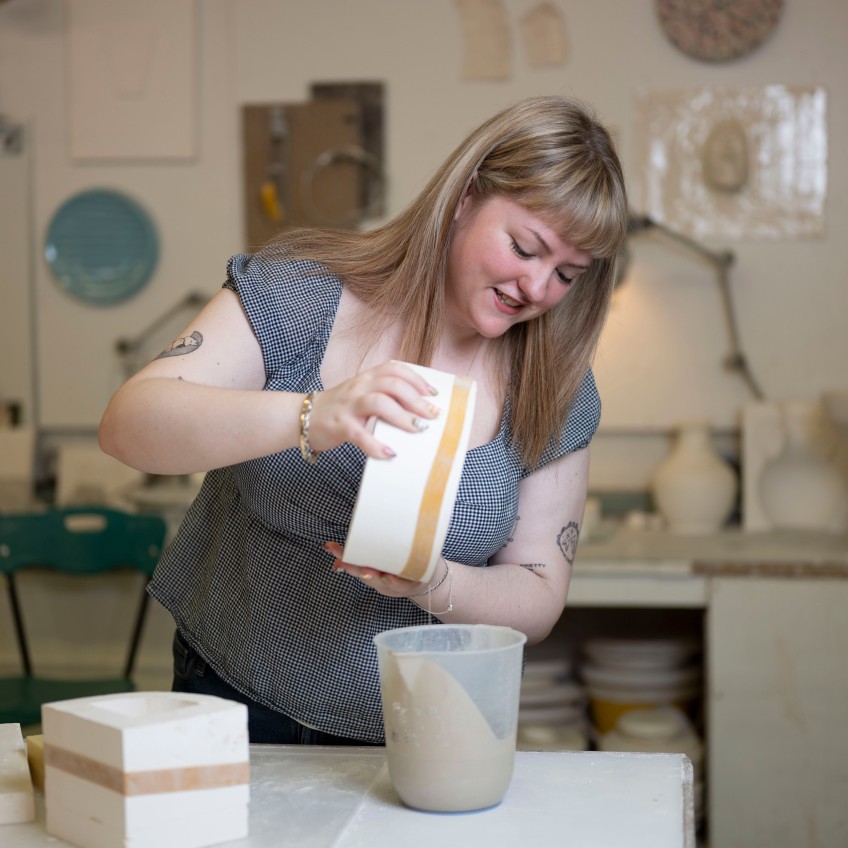
A day in my life at my studio really depends on where I am in my making process. I tend to do things chronologically, so all of my days are spent doing one thing repeatedly until it is done. For example, on a day of casting, I will pour slip into all of my molds I have been wanting to cast that day, set my timers, and then I will typically use this time waiting for my first batch either mixing coloured slip for colour variation samples, or mixing glaze. However, once the first batch of pieces are out of the moulds, I will use the time waiting for the next ones to set to fettle all pieces. I will then repeat this process until I am satisfied with my number of casts for the day (usually about 4-5 of each piece). After I'm happy with the work I’ve done, the casts are all then sent to dry and it's time to clean up!
What are you hoping to explore or push further in your practice over the next year?
Over the next year I hope to explore my true identity as a designer and maker, as my previous projects have been about tailoring designs synonymous with the brands giving the brief. However, in the future I hope to use this clearer idea of my identity, and use it in combination with brands, instead of solely focusing on brand identity. I also hope the next year will give me opportunities to explore and develop previously thought-out concepts while implementing the knowledge and skill I have gained in my time at university.
What do you wish someone had told you when you were studying ceramics?
It is so unbelievably important to stay consistent. There were times I would lose motivation due to constant work, and would decide that I didn't want anything to do with any of my projects. But even if it isn't connected to your current project or wouldn't be perceived as productive, I still really encourage you to keep up with using clay. If you don't use the skill, you’ll lose it.